Villa Scams in Majorca: How to Protect Your Holiday
Ghost properties, fake hosts, and families losing thousands of euros before they even land at Palma airport. Here is everything you need to know — and exactly how to stay safe.
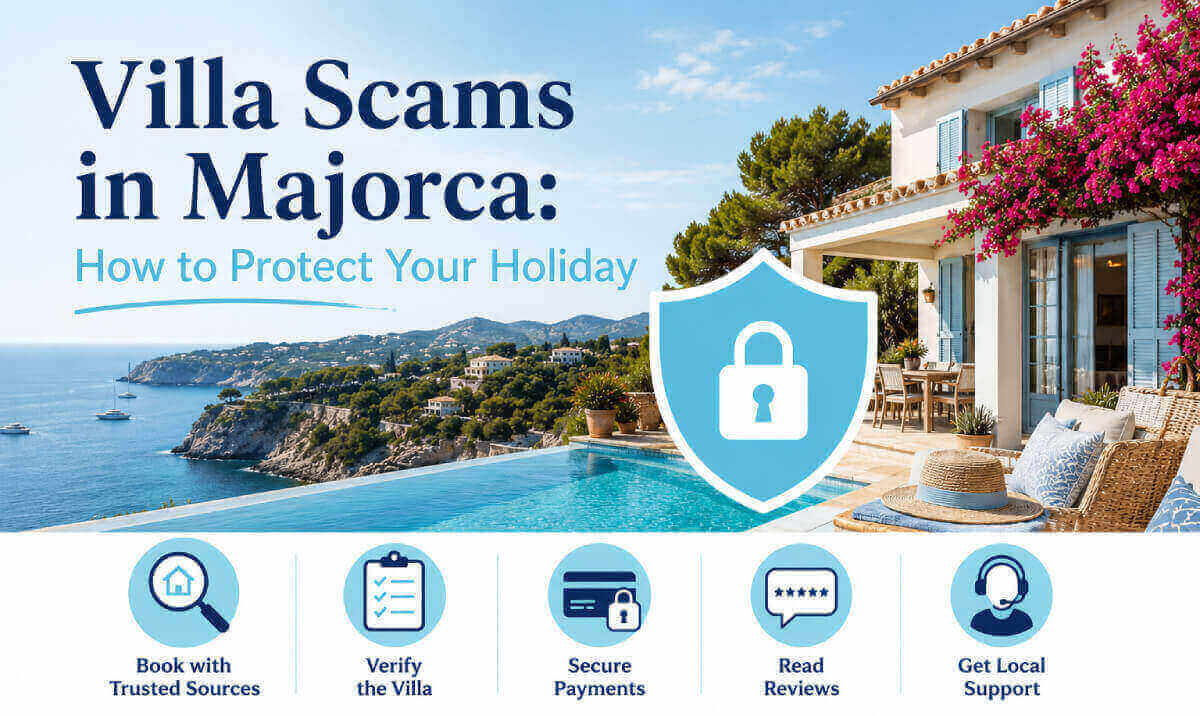
Majorca is one of the most sought-after holiday destinations in Europe, and with that popularity comes an uncomfortable truth: it has also become a prime hunting ground for fraudsters. Every summer, holidaymakers from the UK, Germany, the Netherlands and beyond arrive at Palma airport full of excitement — only to discover that the stunning villa they booked online simply does not exist. The address is wrong, the host is unreachable, and the money is gone.
This is not a rare edge-case. It is happening on a massive, growing scale, and the big rental platforms have been depressingly slow to tackle it. Scammers have become sophisticated: listings look completely real, photos are professionally stolen, and fake reviews are manufactured in bulk. By the time a victim reports the fraud, the money has long since disappeared.
At Villas Mediterranean, we have been welcoming families to Majorca for over a decade. We have seen the damage these scams cause — not just financially, but to what should be a joyful, memorable holiday. That is why we want to give you an honest, detailed guide to what is happening, how to spot it, and how to protect yourself.
Real Cases: It Happens More Than You Think
These are not hypothetical scenarios. The following cases were reported in the press — they represent just a fraction of the fraud that occurs every season in Majorca.
British Family Loses £5,000 — and Finds Strangers Living in "Their" Villa
Chocolate expert Angus Kennedy, his wife Sophie and their five children flew to Mallorca for an Easter villa holiday, having paid close to £5,000 through a website that listed thousands of properties worldwide. Their transfer never arrived. When they eventually took taxis to the finca they had "booked" in S'Esgleieta, the real owner — a German man named Klaus — opened the door bewildered. He had never heard of them. His property was being advertised and rented out fraudulently without his knowledge.
"We showed him the website we had booked with on our phones and his property with a selection of images of the exteriors and interior of his house. He was astonished," Kennedy later told the Majorca Daily Bulletin. The family spent the night as unexpected guests of the real homeowner before scrambling to find alternative accommodation. Their story was later featured in Channel 5's documentary Holiday Scams: Don't Get Caught Out.
Source: Majorca Daily Bulletin
French Holidaymaker Loses €4,000+ — Fraud Tracked to Madrid
A French family booked nine nights in Mallorca through what appeared to be a legitimate rental website, paying just over €4,000. The website subsequently vanished — contact telephone numbers stopped working, links went dead — and the family had no accommodation. French authorities traced the funds to a current account opened in Madrid in the name of a limited company registered in Granada. The case was referred to a Spanish court.
A separate case before the courts in Palma involved a defendant who held an account into which fraudulent booking payments were deposited — but who turned out to be only an intermediary, taking a small percentage while the real perpetrators remained unidentified and at large.
Source: Majorca Daily Bulletin
Wiltshire Family Scammed via Facebook Villa Listing
A family from Wiltshire, England fell victim to a holiday villa scam advertised through Facebook, losing hundreds of pounds in the process. The listing appeared genuine and was promoted on social media — a reminder that fraud is no longer confined to obscure rental websites. Scammers increasingly operate through trusted social platforms where verification is even weaker than on dedicated booking sites.
Source: Salisbury Journal
These cases are far from isolated. As the Majorca Daily Bulletin reported, Spain's National Institute for Cybersecurity has warned repeatedly of the growing threat of fraudulent tourism websites, noting that leading platforms including Airbnb and Booking.com have been used to advertise rentals that turn out to be traps. The Guardia Civil and National Police receive a steady flow of complaints each season, yet prosecutions remain difficult because the real perpetrators are often located abroad and use intermediary accounts to receive payments.
Why the Big Platforms Are Failing Holidaymakers
Platforms like Airbnb operate at enormous scale, processing millions of listings across hundreds of countries and relying heavily on automated systems and user-generated reviews. The model that made them successful — frictionless listing creation, low barriers for hosts — is precisely what fraudsters exploit.
Creating a fraudulent listing takes minutes. Genuinely verifying that the person claiming to own a villa in the southwest of Majorca actually has the right to rent it requires real investigative effort. The economics of running a marketplace at scale push relentlessly towards the former. Despite years of consumer group pressure and high-profile cases in the press, meaningful pre-listing verification of ownership for high-value properties remains inconsistent.
"The real perpetrators of the fraud have not been located, something that makes it very difficult to prosecute this type of fraud."
When fraud does occur, platform refund processes can be slow and exhausting to navigate — at exactly the moment families are most distressed. Even when refunds are eventually granted, they typically cover only the rental cost and not flights, transfers, last-minute hotel bookings, or the far greater cost of a ruined holiday. Social media platforms like Facebook carry even fewer protections, as the Wiltshire family above discovered.
Common Scam Tactics to Watch For
Understanding how these scams work is your first line of defence. Here are the most common methods used by fraudsters targeting Majorca villa bookings.
Ghost Villa Listings
The most prevalent scam. Photos are stolen from legitimate villa websites or estate agents. The property either does not exist as a rental, belongs to an owner who has no idea it is being advertised, or is already occupied by genuine guests. Payment is taken and the fraudster disappears. The Kennedy family case above is a perfect example.
Cloned and Fake Websites
Fraudsters copy legitimate villa company websites wholesale — photos, descriptions, property names, contact details — and host them on a very similar-looking domain. You search for a reputable company, land on a convincing clone, pay in full, and the money goes to scammers. The real company never hears from you until you arrive at a stranger's door.
Social Media Listings
As the Wiltshire case illustrates, fraud is increasingly moving to Facebook and Instagram where verification is minimal. Attractive villa photos and competitive prices are posted directly to buy-and-sell groups, holiday groups, or paid advertisements. The fraudster collects bank transfers from multiple families for the same non-existent property.
Fabricated Reviews
Fake five-star reviews are produced at scale by review farms. A listing with dozens of enthusiastic reviews from accounts created in the same week should raise immediate suspicion. Genuine reviews mention specific details — dates, local restaurants, the name of a beach — rather than generic praise that could apply to any property anywhere.
Immediate Red Flags — Walk Away If You See These
- Prices significantly below the market rate for the area and property size
- Pressure to book immediately — "another family is interested today"
- Host profile created recently with minimal history
- Photos that reverse-image-search to multiple different listings or estate agents
- No independently verifiable business address or phone number
- The listing is on Facebook or social media rather than a traceable company
How to Protect Yourself When Booking a Villa in Majorca
With the right approach, you can book a genuinely beautiful Majorcan villa safely. Here is how.
- Book direct with an established, verifiable company. A company with a real website, a working phone number, a verifiable physical address in Majorca, and years of trading history is the safest option by a significant margin. Search for them independently, check their Google Maps presence and third-party reviews, and call them before you pay a single euro.
- Do a reverse image search on listing photos. Right-click any photo and use Google Images or TinEye. If the same images appear on multiple different listings, estate agent sites, or unrelated web pages, the listing is almost certainly fraudulent.
- Research the company independently. Search the company name alongside "review" and "scam." Look them up on Spanish company registries. Check that their social media accounts have genuine long-term history. A company with no footprint beyond their own website is a concern.
- Be especially careful on social media. Facebook and Instagram listings carry minimal verification. If you discover a villa through social media, treat it as a starting point for research — not as a booking platform. Verify the company through completely independent means before paying anything.
What to Do If You Have Been Scammed
If you believe you have been defrauded, act immediately — every hour matters.
1. Contact the booking platform or website and open a fraud case. Screenshot everything — the listing, all communications, payment confirmations.
2. Call your bank or credit card provider right away to initiate a chargeback or fund recall. There are strict time limits on these processes.
3. File a report with the Spanish police (Guardia Civil) at the local comisaría or through the online cybercrime portal at gdt.guardiacivil.es. A denuncia (police report) is usually required by travel insurers.
4. Report to your national fraud service — Action Fraud in the UK (actionfraud.police.uk), or your national equivalent. This helps build the case files that lead to prosecutions.
5. Contact your travel insurer. Some policies cover holiday fraud. Check your policy carefully and file a claim as quickly as possible.
6. Warn other holidaymakers. Leave reviews on the platform where the fraud occurred and share your experience in travel groups and forums. Victim warnings are often the most effective protection for the next family.
Why Booking Directly With a Trusted Specialist Matters
At Villas Mediterranean, we have been operating in Majorca for over a decade. Every villa in our portfolio is one we know personally — we have visited the properties, verified the licences, met the owners, and we take full responsibility for ensuring everything is as described when you arrive.
We are not a marketplace where anyone can upload photos and create a listing. We are a curated specialist, and that distinction matters enormously when your family holiday and a significant sum of money are at stake.
When you book with us, you get a real team with a real phone number. You get a dedicated contact who knows your villa and the surrounding area. You get a proper rental contract, secure payment methods, and the reassurance of booking with a company that has spent years building its reputation in Majorca — and has every reason to protect it.
We are not suggesting every listing on a large platform is fraudulent. But as the cases above demonstrate, the risk is genuine, it is growing, and the platform infrastructure has not kept pace with the sophistication of the fraudsters. When the stakes are this high — your summer holiday, your family's safety, thousands of euros — the peace of mind that comes from booking directly with a verified specialist is not a luxury. It is simply the sensible choice.
"When you book directly with us, you are not trusting an algorithm or an anonymous profile. You are trusting a team that has been welcoming families to Majorca for over a decade — and we take that responsibility seriously."